Origin
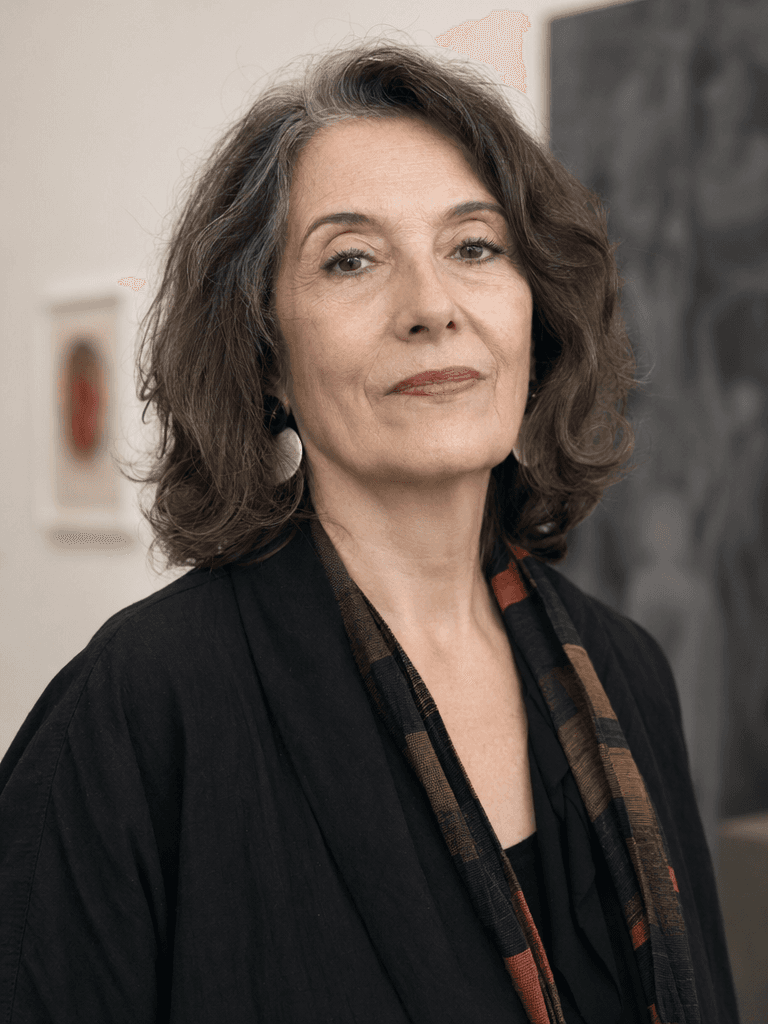
Vivian Sorel’s critical eye was shaped in the gray light of two cities: Lyon, with its layered histories and uncompromising winters, and Boston, with its restless intellectual weather. From the beginning, she was attuned to the dialogue between tradition and rupture—a dialogue that played out on the canvases and in the studios where she first learned to look closely. The formal tension of a Léger composition, the abrupt grace of a Giacometti figure, the audacious material play in a Dubuffet relief: these were her earliest teachers, more precise than any syllabus.
Sorel’s authority is forged in decades spent moving between continents and movements, always returning to the central question: how does art remake the world’s terms, not merely reflect them? Her curatorial path began in the archives of modernist painting, where she developed her fluency in the language of line, color, and surface. This early immersion demanded rigor and skepticism—qualities reinforced by her mentors, many of whom insisted that taste must be earned through encounter, through argument, and through the humility of looking longer than is comfortable.
The postwar European avant-garde provided Sorel with her second crucible. In these circles, she encountered not only the seduction of new materials but also the existential urgency of artists reckoning with a changed world. She learned to prize sensuousness and danger in equal measure, to distrust nostalgia, and to recognize the sly intelligence hidden in formal innovation. Her transatlantic background sharpened her skepticism of received narratives; instead, she is drawn to the blind spots, the restless energies that cross borders and remake art’s possibilities.
Now based in London, Sorel brings nearly four decades of experience to every exhibition and essay. Her voice is incisive, unsentimental, and alert to the stakes of artistic risk. She values intellectual rigor, but never at the expense of material vitality or historical self-awareness. Vivian Sorel does not simply interpret art—she asks what it demands of us, and what we become when we agree to look with her.
Critical Lens
Values
Formal innovationIntellectual rigorHistorical self-awarenessSensuous materiality
Rejects
Nostalgic pasticheArt-as-investment cynicismUnconsidered political sloganeering
The market may be irrational, but the value of a work rests on its capacity to resist fashion and provoke a genuine reordering of perception over time.
Biography
Vivian Sorel is an incisive curator and critical essayist whose career has been shaped by an unyielding devotion to modernist art, a skepticism toward orthodoxy, and a stubborn refusal to succumb to the cycles of fashion and commodification that so often define the contemporary art world. Born in Lyon in 1958, Sorel’s trajectory was set in motion by a formative encounter at age eleven, when she found herself alone one afternoon in a postwar gallery and stood entranced before Alberto Giacometti’s L’homme qui marche. The experience, which she would later describe as “the axis of my seeing,” was less a revelation than a shattering—a sudden awareness of the raw solitude that modern art could embody. This epiphany animated both her scholarly rigor and her curatorial restlessness in the decades to come.
Sorel’s academic path was transatlantic, opening with studies in art history at Boston, where she encountered the rifts—sometimes subtle, sometimes glaring—between American and European approaches to the modern. It was in Boston’s libraries and classrooms that Sorel developed an eye for the overlooked and the undervalued, gravitating toward painters and sculptors on the margins of canon and market. She was drawn not only to the well-trodden ground of early modernism but also to the shadowy precincts of interwar and postwar avant-gardes, particularly those who resisted easy assimilation into commercial circuits.
Her professional discipline was forged in Paris, where in 1982 she joined the Vallon Institute as a curator of modern art. Under the uncompromising mentorship of Claude Joubert, the Vallon's ascetic director, Sorel absorbed a standard of connoisseurship and ethical clarity that would become her hallmark. Those years were marked by her relentless advocacy for artists whose reputations had been eclipsed by the market’s shifting tides. Sorel’s exhibitions at Vallon were known for their precise, often revisionist readings of modernist painting and postwar sculpture, and for challenging received narratives about taste.
The defining trial of Sorel’s career came in 1995 with “Afterimage: The Forgery Scandal,” a landmark exhibition that exposed an intricate web of forgeries within the postwar French art market. The show was a sensation—both for its forensic rigor and for Sorel’s willingness to name uncomfortable truths. While the scandal earned her acclaim for her unflinching integrity, it also brought professional isolation and lasting enmities; dealers and collectors who had profited from the exposed works saw in her not a reformer but a threat. Sorel, undeterred, emerged from the episode with a strengthened resolve, increasingly vocal in her public writings about the dangers of commodification and the necessity of critical skepticism.
In 2008, Sorel relocated to London, assuming the role of Director of Exhibitions at The New Courtyard Trust. There, she became an influential voice in the cross-Channel dialogue on postwar art, interrogating the mythologies that separated—and sometimes united—American and European narratives. Sorel’s criticism, regularly published in leading international journals, is distinguished by its granular attention to form and its relentless questioning of the mechanisms by which art is valued and historicized.
Today, based in London, Vivian Sorel continues to champion the unfashionable, the misattributed, and the misunderstood. Her career stands as a testament to the enduring value of integrity in a field too often governed by expedience, and to the power of a single, transformative encounter with art to set a life’s direction.
Key Moments
1969
The Giacometti Epiphany
At age 11, Vivian stood transfixed before Giacometti's sculpture, shaken by the raw solitude it embodied—a moment she later called 'the axis of my seeing.'
1982
Joining Vallon Institute
Her first curatorial post at Paris's Vallon Institute under the tutelage of the austere, exacting director Claude Joubert left an indelible mark on her standards.
1995
‘Afterimage: The Forgery Scandal’
Vivian curated a headline exhibition that exposed a string of forgeries in postwar French painting, earning both acclaim and professional enemies.
2008
Cross-Channel Criticism
Moving to London, she became a sought-after commentator on the friction between American and European postwar narratives.
Manifesto
1. I demand from art an innovation of form that is more than novelty—an intervention in the conditions of seeing and feeling. The serious artist is not satisfied with rearranging inherited tropes, however seductive. To create is to interrogate the machinery of visual language until it destabilizes, to fracture the ossified and then, with deliberate hand, to reassemble. Consider de Staël’s early paintings, where each brushstroke teeters between assertion and dissolution: uncertainty is not a failure, but the staging ground for new perception. I want art that risks the awkward, the unresolved; art that, in its structure, asks what a picture can be, rather than what it once was.
2. Intellectual rigor is not a matter of citation, but of sustained, critical thought—an art that does not shy from complexity, nor pander with empty gestures to the cause du jour. We are awash in the shallow waters of political one-liners, where slogans masquerade as analysis. I look for work that confronts the conditions of its own making, that understands the lineage it both extends and refutes. The artist’s intelligence must be felt in the weight of decision, in the resistance to cliché and the refusal to indulge in the easy satisfactions of affirmation. I want an art that sharpens the viewer, not flatters them.
3. True historical self-awareness is a corrective to nostalgia, not its enabler. The past is neither a quarry for stylistic mining nor a prop in the theater of relevance. To know history is to acknowledge its presence as fissure and residue, not as costume. I mistrust the art that winks at bygone motifs, content to re-stage them for the market’s appetite for the “timeless.” Instead, I seek work that wrestles with its own inheritance, that exposes the tension between memory and immediacy. The artist should stand in fraught relation to history: adversary and descendant, at once.
4. Sensuous materiality is where thinking and making find their common ground. I am moved by art that insists on the stubborn presence of matter—thick paint, torn fabric, scorched film—where intelligence is embedded in touch and surface, not just in concept. In the best work, substance is not a vehicle for meaning, but a site of it: the eye lingers, uncertain, at the edge of recognition, the hand’s labor refusing to disappear into image. To deny materiality is to deny art’s capacity to confront the senses, and to forfeit the subtle violence of real encounter.
5. Above all, I reject the reduction of art to asset or slogan. The market’s cynicism and the activist’s impatience conspire to flatten art into function—commodity or megaphone. I want work that resists both: irreducible, ambiguous, demanding the prolonged engagement of thought and feeling. Let us ask more of art: that it trouble our habits, unmoor our assumptions, and in doing so, open the field of what might still be possible.